
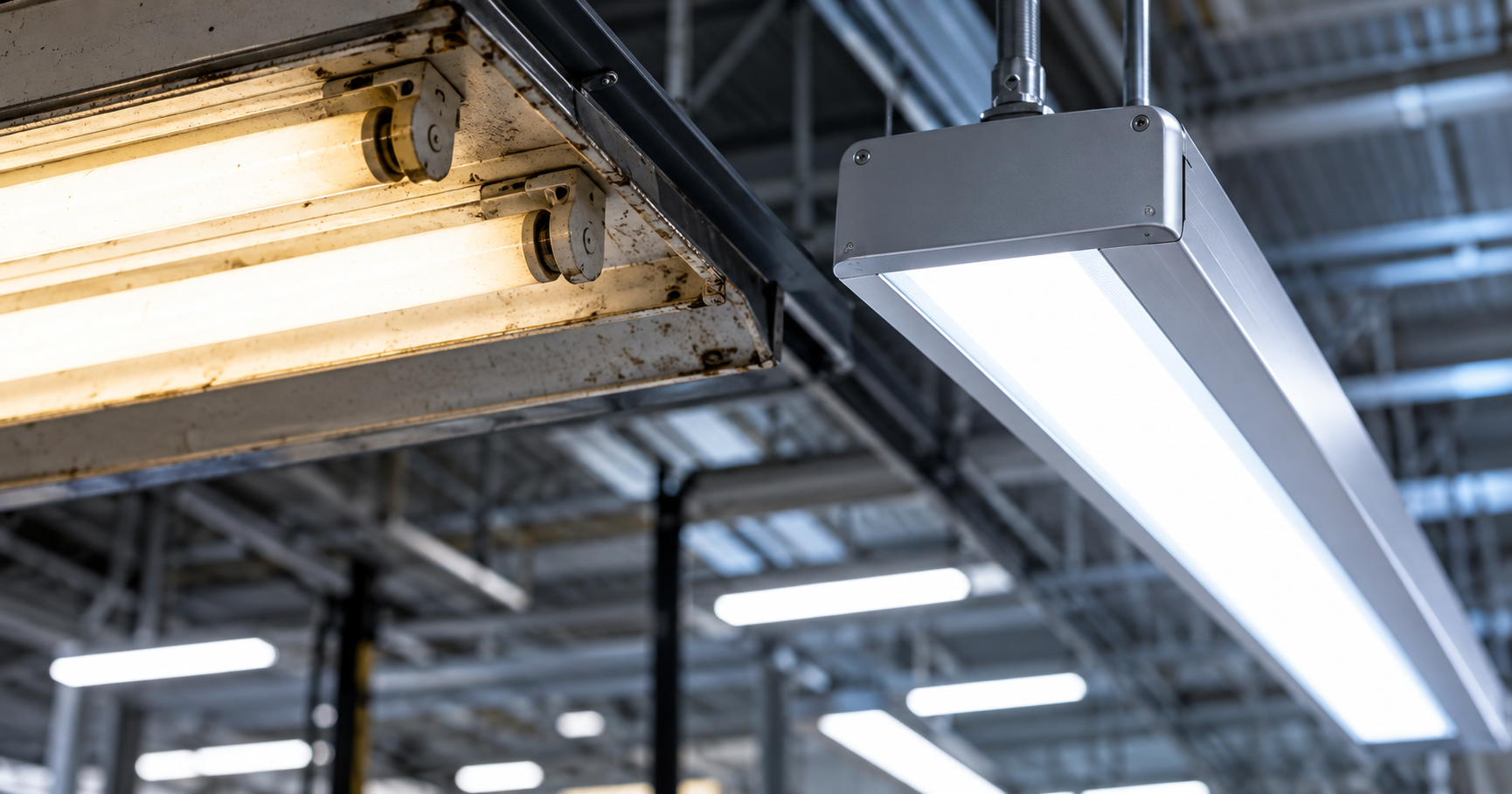
The fluorescent light phase-out in Canada is changing how building owners, electrical contractors, and maintenance teams approach lighting upgrades. With new restrictions taking effect, understanding your LED replacement options is becoming increasingly important.
If you’ve ever walked into a commercial building and heard the familiar buzz of fluorescent lighting, you know the sound.
That faint electrical hum, the occasional flicker, and that one tube in the corner that’s been threatening to retire since 2008.
Well, it might finally be getting its wish.
Canada is moving away from many conventional fluorescent lamps as new regulations restrict their manufacture, import, and eventual sale. And while existing fixtures aren’t suddenly becoming illegal, maintaining older lighting systems is going to become increasingly challenging.
For building owners, maintenance teams, and electrical contractors, that raises an important question:
When your fluorescent lamps reach the end of their life, what’s the smartest replacement?
Do you install an LED replacement tube? Retrofit the existing fixture? Or replace the entire luminaire with something designed for LED technology from the beginning?
The answer isn’t always as simple as swapping one lamp for another.
Ballast compatibility, installation costs, lighting quality, energy efficiency, and long-term maintenance all play a role.
And with conventional lighting products becoming less available, planning ahead is starting to make a lot more sense than waiting until half the office looks like a haunted parking garage.
Let’s look at what’s changing, what it means for Canadian buildings, and how to make the transition to LED without spending money twice.
Why Are Fluorescent Lights Being Phased Out?
Fluorescent lighting has been a workhorse of commercial and industrial buildings for decades.
From office ceilings and warehouses to schools and hospitals, fluorescent lamps have provided relatively efficient, affordable lighting for generations.
And to give credit where it’s due, they served us well.
But technology moves forward, environmental expectations change, and eventually even the most dependable equipment reaches retirement age.
There are three major reasons fluorescent lighting is being phased out.
1. Mercury: The Environmental Problem
Fluorescent lamps contain mercury, a hazardous substance that plays an essential role in producing light inside the lamp.
During normal operation, an intact fluorescent lamp is designed to contain that mercury. The concern arises when lamps break or are improperly handled or disposed of.
Mercury can enter the environment and contribute to contamination of air, soil, and water.
This is one of the primary reasons governments have introduced restrictions on certain mercury-containing lighting products.
Canada’s regulatory changes are connected to its commitments under the Minamata Convention on Mercury, an international agreement aimed at reducing mercury pollution.
Unlike fluorescent lamps, conventional LED lamps do not require mercury to produce light.
That’s a significant environmental advantage, particularly when considering the millions of lamps installed across commercial and institutional buildings.
2. Energy Efficiency: LEDs Have Changed the Game
Fluorescent lighting was once considered an energy-efficient alternative to incandescent lamps.
And compared with older incandescent technology, it certainly was.
But LED technology has raised the bar.
Modern LED lighting systems can produce comparable or better useful illumination while consuming less electricity than many older fluorescent installations.
They also offer opportunities for improved optical control, dimming, occupancy sensing, and daylight-responsive operation.
However, savings depend on the existing equipment and the proposed replacement.
Replacing an inefficient fluorescent installation can produce substantial savings, while replacing a relatively efficient fluorescent system with a poorly selected LED product may deliver a smaller improvement.
The important comparison isn’t simply watts per lamp. It’s the energy required to deliver the right amount of light where it’s needed.
A properly designed LED upgrade should consider light output, distribution, colour quality, glare, and operating hours—not just the number printed on the packaging.
3. Product Availability: The Supply Chain Is Changing
Here’s the part that building owners and maintenance teams really need to pay attention to.
As regulations restrict certain fluorescent lamp products, manufacturers and distributors must adjust their product portfolios.
That means some traditional lamp types will become harder to source as manufacturing changes and remaining inventory is depleted.
And the lamps aren’t the only concern.
Older fluorescent fixtures may also rely on ballasts, lampholders, and other components that become increasingly difficult or uneconomical to replace.
It’s important to understand that Canada’s restrictions don’t mean every existing fluorescent fixture must immediately be removed.
But keeping an aging fluorescent lighting system operational may become more expensive and inconvenient over time.
Imagine managing a building with 300 fluorescent fixtures.
A few lamps fail. Then a ballast fails. Then you discover the replacement lamp you’ve been using for years is no longer readily available.
Suddenly, a routine maintenance job becomes a sourcing exercise worthy of a detective novel.
That’s why the transition to LED should be treated as a maintenance and capital-planning decision—not simply a reaction to burned-out lamps.
The sooner building owners understand what they have installed, the easier it becomes to plan a practical, cost-effective upgrade.
When Are Fluorescent Lamps Being Phased Out in Canada?
Canada’s fluorescent lighting phase-out is already underway, but there’s an important distinction between banning the production of a lamp and requiring someone to replace one that’s already installed.
Under Canada’s Products Containing Mercury Regulations, restrictions on common mercury-containing lamps began on January 1, 2026.
But before anyone starts ripping every fluorescent fixture out of the ceiling, let’s clear something up.
Existing fluorescent lighting installations are not automatically required to be removed because of these federal phase-out dates.
The regulations primarily target the manufacture, import, and eventual sale of affected lamps, with transitional exemptions for certain replacement products.
The Important Dates
Here’s how the phase-out works for common lighting products:
| Lamp Type | Key Dates |
|---|---|
| Screw-base compact fluorescent (CFL) | Manufacture and import prohibited starting January 1, 2026; remaining inventory may still be sold |
| Pin-base compact fluorescent (CFL) | Restrictions began January 1, 2026; qualifying replacement lamps can be manufactured or imported through December 31, 2027; sales prohibited January 1, 2030 |
| Straight fluorescent lamps (including T5, T8 and T12) | Same replacement transition and January 1, 2030 sales prohibition |
| Non-linear fluorescent lamps | Same replacement transition and January 1, 2030 sales prohibition |
| Metal halide and high-pressure sodium | Manufacture and import restrictions for specified metal halide and high-pressure sodium lamps begin January 1, 2029. Certain qualifying replacement lamps are exempt from these restrictions, subject to the conditions in the regulations. These products do not share the general January 1, 2030 fluorescent replacement-lamp sales deadline. |
Important clarification: The January 1, 2030 sales prohibition applies to specified fluorescent replacement lamps, including qualifying pin-base compact fluorescent, straight fluorescent, non-linear fluorescent, and induction fluorescent lamps. Other lamp categories have different rules and exemptions. The federal phase-out does not, by itself, require building owners to remove existing fluorescent fixtures by that date.
These dates apply to the relevant general-lighting products, subject to the regulations’ definitions and exemptions.
What Does This Mean for Existing Buildings?
If you’re managing a building full of T8 fluorescent fixtures, there’s no federal requirement under this phase-out to replace every fixture tomorrow.
However, the clock is ticking on the supply of conventional replacement lamps.
Qualifying fluorescent replacement lamps can continue to be manufactured or imported during the transition period, and certain existing inventories may remain available until the sales prohibition takes effect.
For contractors, that creates an opportunity to help customers develop a replacement strategy rather than waiting for emergency maintenance calls.
For building owners, it means taking stock of existing lighting equipment, evaluating LED alternatives, and deciding where upgrades make the most financial sense.
Why Planning Ahead Matters
Imagine managing an apartment building, warehouse, or office complex with hundreds of fluorescent fixtures.
Replacing a few lamps every month might seem manageable today.
But what happens when the lamps become harder to obtain, prices change, or compatible replacement products are no longer available?
Suddenly, a simple maintenance task becomes a capital project.
And nobody wants to explain to the building owner that the lighting budget has gone from replacing a handful of tubes to replacing half the ceiling.
The smart approach isn’t necessarily replacing everything immediately. It’s understanding what you have, what replacement options exist, and when an upgrade makes financial sense.
That brings us to the next question: should you use LED replacement lamps, retrofit the existing fixtures, or install entirely new LED luminaires?
LED Replacement Lamps vs. Retrofit Kits vs. New Fixtures
So, your fluorescent lamps are on their way out. Now what?
Fortunately, upgrading to LED doesn’t always mean tearing out perfectly good fixtures and starting from scratch.
There are three main approaches: installing LED replacement lamps, using retrofit kits, or replacing the entire luminaire.
Each has advantages, limitations, and situations where it makes the most sense.
Option 1: LED Replacement Lamps — The Quick Upgrade
LED replacement tubes are designed to replace traditional fluorescent lamps in compatible fixtures.
They’re often the most economical way to upgrade an existing lighting installation, particularly when the fixtures themselves are still in good condition.
But here’s where things get interesting.
Not all LED tubes work the same way.
Type A — Ballast-Compatible LED Tubes
These operate using a compatible existing fluorescent ballast.
The advantage? Installation can be relatively straightforward, with minimal modifications to the fixture.
The downside? You’re still relying on an aging ballast.
If that ballast fails, your shiny new LED tube isn’t going to be particularly useful until the issue is addressed.
Always verify ballast compatibility using the LED manufacturer’s documentation.
Type B — Ballast-Bypass LED Tubes
These operate directly from the supply voltage after the fluorescent ballast is disconnected or removed.
That eliminates the ballast as a future maintenance item.
However, the fixture must be modified according to the lamp manufacturer’s instructions, including the specified lampholder wiring arrangement and required markings.
This is electrical work, not simply changing a light bulb.
Type C — External-Driver LED Tubes
These use a dedicated LED driver installed in place of the fluorescent ballast.
They can offer additional control capabilities and a coordinated lamp-and-driver system.
However, they generally involve more installation work and additional components.
The takeaway: LED replacement tubes can be an excellent solution, but contractors need to evaluate the existing fixture, electrical configuration, product certification, and manufacturer’s installation requirements before recommending them.
Option 2: LED Retrofit Kits — A Middle Ground
Sometimes the existing fixture housing is worth keeping, but the fluorescent components inside have reached the end of their useful life.
That’s where LED retrofit kits come in.
A retrofit kit replaces or modifies the lighting components inside an existing luminaire while retaining approved portions of the original housing.
Depending on the product, that may include new LED modules, drivers, mounting components, and optical assemblies.
Retrofit kits can be particularly attractive for commercial and institutional buildings where removing and replacing entire fixtures would involve substantial labour or ceiling disruption.
They may also offer better light distribution and system efficiency than simply installing LED replacement tubes.
But compatibility matters.
Not every retrofit kit is approved for every existing fixture.
Contractors must follow the retrofit manufacturer’s instructions and verify that the resulting installation complies with applicable certification and electrical code requirements.
Option 3: Complete LED Fixture Replacement — The Long-Term Solution
Sometimes the best solution is to retire the entire fluorescent fixture.
Modern LED luminaires are designed around LED technology from the beginning.
That means the light source, driver, optics, thermal management, and housing are engineered as a complete system.
Depending on the product, this can provide improved lighting performance, better control integration, and a more predictable maintenance strategy.
Complete replacement is particularly worth considering when existing fixtures are damaged, poorly located, inefficient, or incompatible with modern lighting controls.
It’s also an opportunity to reconsider the lighting design itself.
Maybe the old fixtures were installed 25 years ago when the building had a completely different purpose.
Maybe the light levels are excessive in some areas and inadequate in others.
Or maybe the fixtures have been collecting dust since dial-up internet was considered cutting-edge technology.
A complete replacement gives designers and contractors an opportunity to improve the installation rather than simply replicate it.
Which LED Upgrade Is Best?
There isn’t one correct answer for every project.
| Upgrade Method | Initial Cost | Installation Complexity | Best Application |
|---|---|---|---|
| Type A LED tubes | Often lowest | Low, when compatible | Good-condition fixtures with compatible ballasts |
| Type B LED tubes | Low to moderate | Moderate | Existing fixtures where ballast removal is practical |
| Type C LED tubes | Moderate | Moderate | Projects suited to dedicated LED drivers |
| LED retrofit kits | Moderate | Varies by kit | Retaining suitable fixture housings |
| New LED fixtures | Often highest | Moderate to high | Major renovations and long-term upgrades |
These are general comparisons. Actual costs depend on the product, site conditions, installation labour, and project scale.
The lowest upfront cost isn’t always the lowest lifetime cost.
A building owner might save money today by installing ballast-compatible LED tubes, only to face additional maintenance costs when the original ballasts begin failing.
On the other hand, replacing hundreds of perfectly serviceable fixtures may not be financially justified when a properly certified retrofit solution would deliver comparable results.
The best recommendation considers installation costs, energy savings, maintenance, expected service life, lighting quality, and future control requirements.
And that’s where a knowledgeable electrical contractor becomes more valuable than a product catalogue.
One important safety note: Before installing LED replacement lamps or retrofit kits, verify the product’s Canadian certification, the suitability of the existing fixture, the manufacturer’s instructions, and applicable electrical code requirements. Modified luminaires must be assessed according to the relevant approved retrofit system and installation requirements.
How Much Can You Save by Switching to LED?
Energy efficiency is one of the biggest selling points of LED lighting, but building owners usually have a more immediate question:
How much money is this actually going to save me?
And that’s a fair question.
Because while lower energy consumption sounds wonderful, it doesn’t mean much to a building owner unless we can translate those kilowatt-hours into actual dollars.
Let’s run through an example.
A Practical Example: Upgrading 100 Fluorescent Fixtures
Imagine a commercial building with 100 fluorescent fixtures, each containing two 32-watt T8 lamps.
For this example, we’ll assume the existing fluorescent ballast adds approximately 8 watts of consumption per fixture.
That gives us:
- Existing fixture consumption: 72 watts
- Proposed LED fixture consumption: 30 watts
- Number of fixtures: 100
- Annual operating hours: 3,000
- Electricity rate: $0.15 per kWh
These are illustrative assumptions, not measurements from a specific building.
Existing annual energy consumption:
100 × 72 W × 3,000 hours ÷ 1,000 = 21,600 kWh
Proposed annual LED energy consumption:
100 × 30 W × 3,000 hours ÷ 1,000 = 9,000 kWh
Annual energy savings:
21,600 − 9,000 = 12,600 kWh
At $0.15 per kWh, that’s approximately $1,890 in annual electricity savings.
Not bad for changing what’s hanging above your head.
What About the Payback Period?
Let’s assume the complete LED upgrade costs $8,000, including materials and installation.
With annual electricity savings of $1,890:
$8,000 ÷ $1,890 = approximately 4.2 years of simple payback.
After that point, the cumulative electricity savings exceed the original investment, assuming the operating conditions and electricity rate remain constant.
And that’s before considering any reduction in lamp and ballast maintenance.
Maintenance Savings Can Change the Equation
Electricity isn’t the only expense associated with lighting.
There’s also the cost of replacement lamps, ballasts, labour, equipment rentals, and disruption to building operations.
In facilities with high ceilings or difficult-to-access fixtures, maintenance can represent a substantial expense.
LED systems can reduce the frequency of routine lighting maintenance when appropriately selected and operated.
However, LED products aren’t maintenance-free. Drivers and other components can still fail, and actual service life depends on operating conditions and product quality.
A useful return-on-investment calculation should include realistic maintenance assumptions rather than treating every LED fixture as immortal.
Don’t Forget Lighting Controls
An LED upgrade can also create opportunities to install occupancy sensors, daylight-responsive controls, scheduling, and dimming systems.
These technologies may reduce energy consumption beyond what is achieved by replacing the light source alone.
For example, a storage room doesn’t necessarily need full lighting output when nobody is inside.
And illuminating an empty meeting room all weekend is a wonderful way to make your electricity meter feel appreciated.
Controls savings depend on occupancy patterns, daylight availability, system configuration, and user behaviour. They shouldn’t be assumed without evaluating the application.
Calculate Your Own LED Upgrade Savings
Every building is different.
A warehouse operating around the clock will have a very different payback period from an office operating five days per week.
Electricity rates, fixture quantities, installation costs, and maintenance requirements all influence the result.
That’s why we’ve developed The Current’s Lighting ROI Calculator.
It allows you to compare existing and proposed lighting systems, estimate annual energy savings, and evaluate the financial return of an upgrade.
Whether you’re a contractor preparing a recommendation or a building owner considering a renovation, having actual numbers makes the decision considerably easier.
Because the best lighting upgrade isn’t necessarily the one with the biggest advertised energy savings.
It’s the one that delivers the right lighting performance at a cost that makes sense for the project.
What Should Contractors and Building Owners Do Now?
Knowing that fluorescent lighting is being phased out is one thing.
Knowing what to do about it is another.
For electrical contractors, this transition presents an opportunity to help customers make informed decisions rather than simply reacting to failed lamps and ballasts.
For building owners, it’s an opportunity to evaluate operating costs, maintenance requirements, and long-term capital investments.
The good news? You don’t need to replace every fluorescent fixture tomorrow.
You do, however, need a plan.
Step 1: Conduct a Lighting Audit
Before recommending an upgrade, understand what’s already installed.
A basic lighting audit should document:
- Fixture quantities, types, and locations
- Existing lamp types and wattages
- Ballast types and approximate condition
- Annual operating hours
- Existing lighting controls
- Areas with recurring maintenance problems
- Current lighting quality and occupant concerns
Don’t overlook the importance of identifying different fixture configurations throughout the building.
A facility might contain T8 lamps in the offices, T5 high-output fixtures in the warehouse, and compact fluorescents in corridors.
Each application may require a different replacement strategy.
And if the building has been renovated several times, there’s a reasonable chance you’ll discover at least one lighting installation that makes you question the decisions of previous generations.
Step 2: Identify Priority Areas
Not every fixture needs to be replaced at the same time.
Start by identifying areas where upgrades could provide the greatest benefit.
High-priority candidates often include:
- Fixtures operating for extended hours
- Areas with frequent lamp or ballast failures
- Locations requiring lifts or specialized maintenance access
- Spaces with inadequate or inconsistent illumination
- Fixtures that are damaged or nearing the end of their useful life
A warehouse operating 24 hours per day may offer greater energy-saving opportunities than a storage room used for only a few hours each week.
Likewise, replacing difficult-to-access fixtures may provide maintenance savings beyond the electricity reduction.
The goal is to prioritize improvements based on actual operating conditions rather than treating every fixture equally.
Step 3: Compare Replacement Options
Once the existing installation is documented, evaluate the available LED solutions.
For some applications, compatible LED replacement lamps may be sufficient.
Others may benefit from certified retrofit kits or complete fixture replacement.
Consider the total project cost, expected energy savings, maintenance requirements, lighting performance, and compatibility with future controls.
Also consider product availability and consistency.
Choosing a widely supported fixture family with documented specifications and replacement components can simplify future maintenance.
Nobody wants to discover three years later that their replacement driver is harder to find than a 10 mm socket.
Step 4: Build a Phased Replacement Plan
For larger buildings, replacing every fixture at once may not be practical.
A phased approach allows upgrades to be scheduled around maintenance budgets, tenant requirements, and planned renovations.
For example, a property manager might begin with common areas and high-use spaces before upgrading individual offices or suites.
This can spread capital costs over multiple budget periods while addressing the most urgent requirements first.
However, phased projects should maintain consistent lighting specifications wherever practical.
Mixing different colour temperatures, fixture styles, and light outputs can create an inconsistent result.
A well-planned upgrade should look intentional—not like the lighting department held a clearance sale.
Step 5: Plan for Proper Disposal and Recycling
Fluorescent lamps contain mercury and should be handled and disposed of through appropriate collection and recycling programs.
Contractors and building owners should follow applicable provincial and local requirements for storing, transporting, and recycling spent lamps.
In Saskatchewan, verify current disposal and recycling options with the relevant waste-management or hazardous-waste service provider before starting a large project.
Broken lamps require additional care because of their mercury content.
Proper disposal should be included in the project scope and budget rather than treated as an afterthought.
Step 6: Work With Your Electrical Contractor and Distributor
A successful lighting upgrade involves more than choosing a replacement lamp.
Electrical contractors can assess existing installations, evaluate installation requirements, and help ensure the selected solution is suitable for the application.
Electrical distributors can assist with product selection, technical documentation, availability, and sourcing consistent product families across a project.
For larger upgrades, involving manufacturers and lighting specialists early can help identify compatibility issues and improve the overall design.
The objective is straightforward:
Select the right product, install it correctly, and avoid creating tomorrow’s maintenance problem with today’s lighting upgrade.
The fluorescent phase-out doesn’t have to become an emergency.
With a little planning, it can become an opportunity to improve lighting performance, reduce operating costs, and modernize buildings on a sensible schedule.
The Bottom Line: Don’t Wait Until the Lights Go Out
Fluorescent lighting has had a pretty good run.
For decades, it illuminated everything from classrooms and office buildings to warehouses, hospitals, and the occasional basement workshop where the lights took three attempts to turn on.
But the electrical industry is changing, and lighting technology is moving forward.
Canada’s fluorescent lamp phase-out is another reason for building owners and electrical contractors to start thinking about what comes next.
The good news is that there isn’t a one-size-fits-all solution.
Some buildings may benefit from straightforward LED lamp replacements. Others will see better long-term value from retrofit kits or complete luminaire upgrades.
The important thing is making an informed decision based on the existing installation, operating costs, lighting requirements, and available budget.
Don’t replace lighting simply because it’s old. Replace it because the new solution makes sense.
And don’t wait until replacement lamps become difficult to source before figuring out what your options are.
A little planning today can prevent a much more expensive headache tomorrow.
Ready to Run the Numbers?
Before committing to a lighting upgrade, find out what the potential savings could look like.
Try The Current’s Lighting ROI Calculator to estimate electricity savings, operating costs, and simple payback for your project.
Whether you’re upgrading ten fixtures or ten thousand, a little math can help keep your lighting investment from becoming a shot in the dark.
Stay curious. Stay current.
Keep the Current Flowing
Interested in making your next electrical upgrade smarter? Explore more of The Current’s practical guides covering lighting controls, energy efficiency, and emerging electrical technology.



2 thoughts on “Fluorescent Light Phase-Out in Canada: LED Upgrade Guide.”