
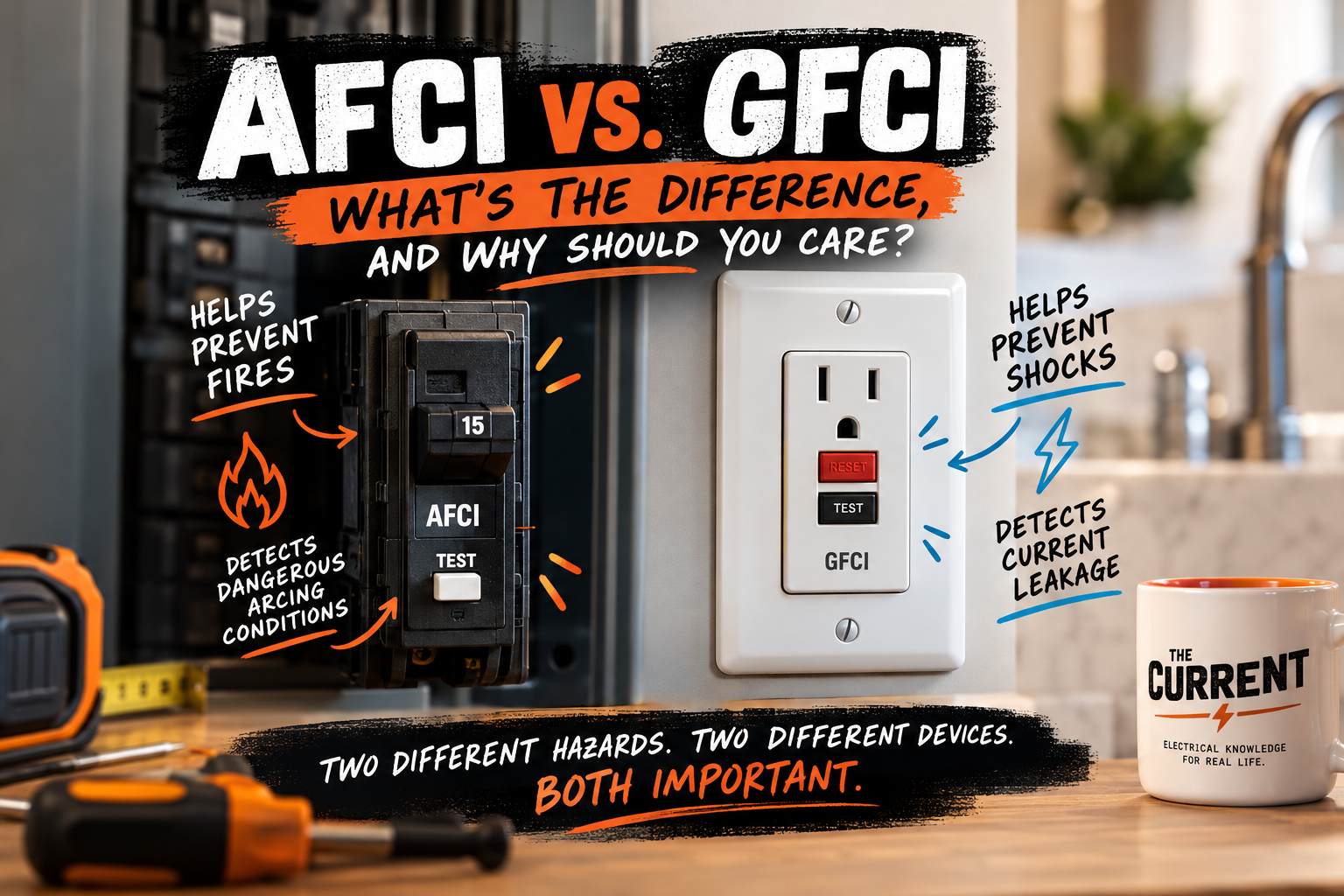
One helps prevent elAFCI vs. GFCI: What’s the Difference, and Why Should You Care?
One helps prevent electrical fires. The other helps prevent electric shocks. Neither one is particularly impressed by your DIY confidence.
If you’ve ever stood in the electrical aisle staring at a circuit breaker labelled AFCI or a receptacle labelled GFCI, wondering whether someone just dropped a bowl of alphabet soup into the electrical code, you’re not alone.
The electrical industry has a love affair with acronyms.
And while some of them seem designed specifically to confuse homeowners, AFCI and GFCI protection are two of the most important electrical safety technologies in modern homes.
They might look similar. They might both have TEST buttons. They might even live together in the same electrical panel.
But they’re doing two very different jobs.
Let’s break it down before someone decides that replacing a tripping breaker with a regular one is a reasonable troubleshooting strategy.
Spoiler alert: it isn’t.
GFCI: Because You Shouldn’t Be Part of the Circuit
GFCI stands for Ground-Fault Circuit Interrupter.
Its primary purpose is to help protect people from electric shock.
Under normal conditions, the electrical current leaving through the ungrounded conductor should return through the intended circuit path.
A GFCI constantly compares the current going out with the current coming back.
If there’s a difference beyond its operating threshold, the device trips and disconnects the power.
Why?
Because that missing current might be flowing somewhere it shouldn’t.
Through damaged insulation. Through wet equipment. Or, in a particularly unfortunate situation, through you.
And while the human body is technically capable of conducting electricity, it’s not exactly a feature worth advertising on LinkedIn.
Where are GFCIs commonly used?
You’ll often encounter GFCI protection in areas where moisture or other conditions increase the risk of electric shock.
Examples include:
- Bathroom receptacles near sinks.
- Outdoor receptacles.
- Receptacles near kitchen sinks.
- Certain receptacles associated with spas, hot tubs, and pools.
- Other installations where the applicable electrical code requires ground-fault protection.
Here’s where we need to clear something up.
Not every receptacle in a garage, kitchen, or basement automatically requires GFCI protection simply because of the room it’s in.
The Canadian Electrical Code uses specific installation conditions, distances, equipment types, and circuit requirements to determine where protection is necessary.
That’s why using an American wiring diagram to determine Canadian electrical code requirements can be a little like using a Texas weather forecast to plan your Saskatchewan winter.
Interesting, perhaps. Reliable? Not so much.
What a GFCI doesn’t do
A GFCI isn’t a replacement for a properly installed grounding and bonding system.
It also doesn’t protect against every possible electric shock. For example, contact between the hot and neutral conductors may not create the current imbalance needed to trip it.
And it isn’t designed to identify the dangerous arcing conditions that an AFCI detects.
Which brings us to our next contestant.
AFCI: The Electrical Fire Prevention Specialist
AFCI stands for Arc-Fault Circuit Interrupter.
Its primary purpose is to help reduce the risk of electrical fires caused by certain dangerous arcing faults.
An electrical arc occurs when current travels across a gap or through an unintended conductive path.
Some arcing is perfectly normal.
Flip a light switch, and a small arc may occur as the contacts open or close.
But arcing caused by damaged wiring, deteriorating insulation, or certain failing connections can produce enough heat to ignite surrounding materials.
That’s where an AFCI comes in.
These devices monitor electrical characteristics and are designed to recognize certain hazardous arcing patterns.
When the device detects a qualifying fault, it disconnects the circuit.
Think of an AFCI as a security guard for your electrical wiring.
Except instead of watching someone steal a chocolate bar, it’s watching for electrical behaviour that could turn your wall cavity into a campfire.
Where is AFCI protection used?
Under the Canadian Electrical Code, AFCI protection is relevant to many dwelling-unit receptacle circuits, with specific exceptions.
Common examples include receptacle circuits serving living rooms, bedrooms, dining rooms, and similar residential spaces.
However, some circuits and receptacle locations are treated differently under the rules.
For Saskatchewan installations, electricians need to refer to the adopted 2024 Canadian Electrical Code and applicable provincial interpretations.
The important takeaway: AFCI requirements are determined by the applicable rules and circuit arrangement, not simply by whether a room has carpet and a couch.
What an AFCI doesn’t do
An AFCI doesn’t replace GFCI protection where GFCI protection is required.
It also doesn’t detect every possible electrical fire hazard.
Overloaded circuits, improper conductor sizing, defective equipment, and poor electrical workmanship still need to be addressed.
AFCIs are an important layer of protection.
They’re not magic.
Although, compared to the electrical systems in some older houses, they might seem pretty close.
AFCI vs. GFCI: The Showdown Nobody Asked For
Let’s put them side by side.
| Feature | AFCI | GFCI |
|---|---|---|
| Full name | Arc-Fault Circuit Interrupter | Ground-Fault Circuit Interrupter |
| Primary purpose | Help reduce electrical fire risk | Help reduce electric shock risk |
| Detects | Certain dangerous arcing conditions | Differences between outgoing and returning current |
| Common device | Circuit breaker | Receptacle or circuit breaker |
| Can replace the other? | No | No |
| TEST button? | Typically, yes | Typically, yes |
The easiest way to remember the difference:
AFCI = Fire protection.
GFCI = Shock protection.
Two different hazards. Two different technologies.
And sometimes, one circuit needs both.
Can You Have AFCI and GFCI Protection Together?
Absolutely.
Manufacturers offer dual-function AFCI/GFCI circuit breakers that provide both types of protection.
These devices can be useful where the applicable installation requirements call for both.
For example, a particular circuit configuration may require arc-fault protection while a receptacle or connected equipment also requires ground-fault protection.
Depending on the installation, the necessary protection might be provided by a suitable combination device or by appropriately arranged separate devices.
But here’s an important distinction.
A dual-function AFCI/GFCI breaker is not the same thing as a standard combination-type AFCI breaker.
The term combination-type AFCI refers to an AFCI classification. It doesn’t automatically mean the breaker also provides Class A GFCI protection.
Confusing the two is an excellent way to order the wrong product and discover your mistake after the electrical supplier closes.
Ask me how I know.
Actually, don’t.
Why Does My AFCI or GFCI Keep Tripping?
Ah, the age-old question.
“Why does this stupid breaker keep tripping?”
Well, there’s a chance it’s doing exactly what you paid it to do.
If your GFCI keeps tripping
Possible causes include:
- Moisture entering electrical equipment.
- Damaged appliance cords.
- Deteriorated insulation.
- Leakage current from connected equipment.
- Wiring faults.
If your AFCI keeps tripping
Possible causes include:
- Damaged or pinched wiring.
- Certain loose or failing electrical connections.
- Damaged cords.
- Faulty connected equipment.
- Other conditions that require investigation.
Not every trip means there’s a dangerous fault. Equipment characteristics and device compatibility can sometimes complicate troubleshooting.
But repeatedly resetting the device without investigating isn’t the answer.
And replacing it with an ordinary breaker because it keeps tripping?
That’s like taking the batteries out of your smoke alarm because your cooking keeps setting it off.
Congratulations. You’ve solved the noise.
Not the problem.
What should you do?
If it’s safe, unplug connected equipment and follow the device manufacturer’s troubleshooting and testing instructions.
If the device won’t reset or continues to trip, contact a qualified electrician.
Don’t bypass, modify, or defeat the protection.
Testing: That Little Button Isn’t Decoration
Most modern AFCI and GFCI devices include a TEST button.
And no, it’s not there to give you something to press when you’re bored.
Manufacturers provide testing procedures and recommended intervals to help confirm that their devices operate as intended.
Follow those instructions.
If a device fails its prescribed test, it should be investigated and replaced where necessary by a qualified person.
Remember that pressing TEST doesn’t prove every connection and conductor in the installation is correct.
It tests the device’s specified function.
Useful? Absolutely.
A substitute for proper installation and inspection? Not even close.
Where Do You Actually Need AFCI and GFCI Protection?
This is the question everyone wants answered.
And it’s also where the electrical code likes to remind us that nothing is ever quite as simple as a Facebook comment section makes it sound.
Here’s a practical starting point for Canadian homes.
| Location | Protection to consider |
|---|---|
| Bedrooms and living rooms | AFCI requirements commonly apply to receptacle circuits |
| Dining rooms and similar living areas | AFCI requirements commonly apply |
| Bathrooms | GFCI requirements for applicable receptacles near sinks; check AFCI exceptions |
| Kitchen counters | Check specific GFCI distance requirements and AFCI exceptions |
| Outdoor receptacles | GFCI protection is commonly required, subject to applicable conditions |
| Garages and workshops | Evaluate the particular receptacle, circuit, and equipment requirements |
| Hot tubs and spas | Specific GFCI and equipment installation rules apply |
Important: This table is an educational overview, not a complete compliance checklist. It doesn’t determine protection solely by room name. Always verify the applicable Canadian Electrical Code requirements, Saskatchewan amendments or interpretations, and equipment instructions.
A note for Saskatchewan homeowners and contractors
Saskatchewan adopted the 2024 Canadian Electrical Code, effective June 1, 2025.
That means installations need to be evaluated against the code and provincial requirements applicable to the work.
When planning a renovation, service upgrade, or new circuit, discuss the necessary protection with your electrician before purchasing devices.
Because buying the wrong $80 breaker is annoying.
Installing the wrong protection is considerably worse.
The Bottom Line
AFCI and GFCI protection aren’t competing technologies.
They’re teammates.
One is designed to help prevent electrical fires associated with certain arcing faults.
The other is designed to help protect people against electric shock caused by ground faults.
Neither replaces good wiring practices, proper installation, or qualified electrical work.
And neither should be bypassed because it’s inconveniencing your Saturday afternoon.
The next time you see a TEST button on a breaker or receptacle, remember there’s a pretty important reason it’s there.
Electrical safety isn’t complicated because electricians enjoy making things difficult.
Well, not entirely.
It’s complicated because electricity doesn’t offer much forgiveness when things go wrong.
Want the Cheat Sheet? We’ve Got You.
Nobody wants to memorize electrical code requirements over their morning coffee. That’s why we’ve put together a free, downloadable AFCI vs. GFCI Practical Guide.
Get the differences, common applications, troubleshooting tips, and Saskatchewan code considerations in one handy PDF.
Disclaimer: This article provides general electrical education and is not a substitute for the Canadian Electrical Code, provincial requirements, manufacturer instructions, permits, inspections, or professional electrical advice. Electrical work must comply with applicable local requirements and be performed by appropriately qualified persons.