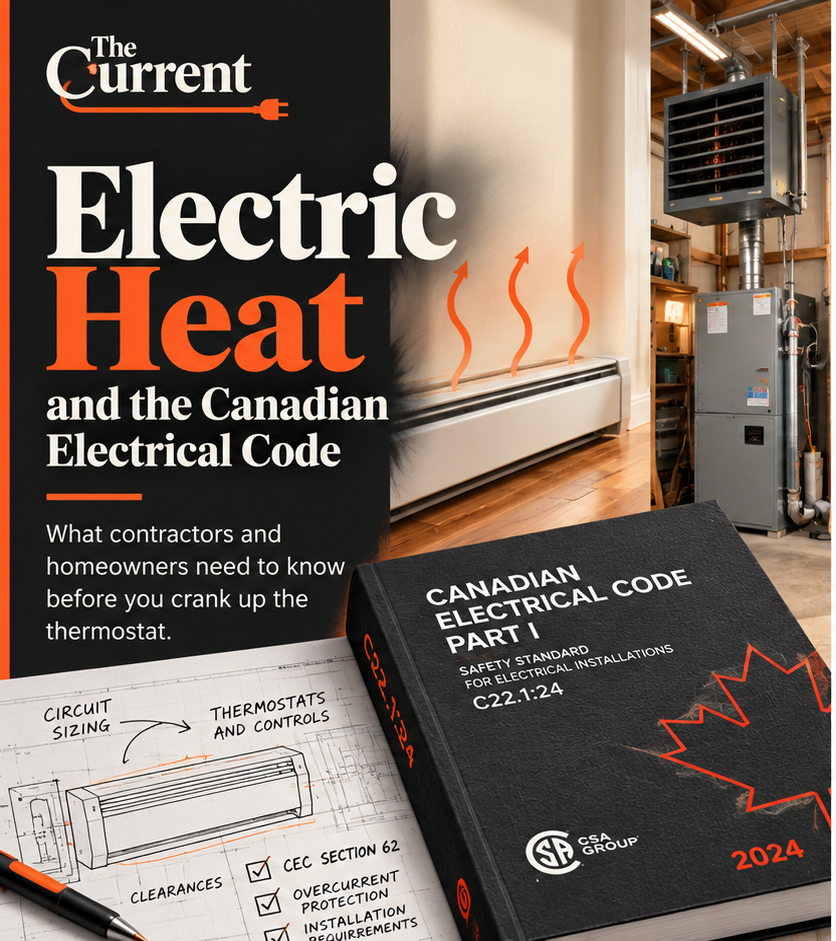
From baseboard heaters to electric furnaces, here’s what contractors and homeowners should understand about electric heating, circuit sizing, and the 2024 Canadian Electrical Code.
When you live in Saskatchewan, heating isn’t exactly optional.
Between the freezing temperatures, howling prairie winds, and those mornings when your vehicle sounds like it’s negotiating its own retirement, keeping buildings warm is serious business.
Electric heat has been around for decades. It’s relatively straightforward, available in several configurations, and can be an excellent solution for everything from residential bedrooms to commercial workshops.
But there’s a catch.
Just because a heater has two wires and a thermostat doesn’t mean you can connect it to whatever circuit happens to be nearby.
Electric heating introduces some important electrical considerations, particularly when it comes to continuous loads, conductor sizing, overcurrent protection, and installation clearances.
And that’s where the Canadian Electrical Code comes in.
Let’s turn up the heat on Section 62.
1. Electric Heat: More Than Just Baseboards
When most people think of electric heat, they picture the familiar baseboard heater sitting underneath a window.
But electric heating systems cover considerably more territory.
Electric baseboard heaters
Common in homes, apartments, and smaller commercial spaces, baseboard heaters use electrical resistance elements to generate heat.
They’re relatively simple, require little mechanical maintenance, and allow individual room temperature control.
Electric wall and fan-forced heaters
These units use heating elements and, in many cases, a fan to distribute warm air.
You’ll commonly find them in entryways, bathrooms, garages, and smaller workspaces.
Electric unit heaters
Unit heaters are commonly installed in commercial buildings, workshops, warehouses, and garages.
Depending on the model, they may include contactors, fans, integral thermostats, and multiple heating stages.
They’re also a good reminder that not all electric heating equipment has the same electrical requirements.
Electric furnaces
Electric furnaces use resistance heating elements to heat air distributed through ductwork.
Unlike a small baseboard heater, an electric furnace can introduce a substantial electrical load.
A 20 kW electric furnace isn’t something you casually squeeze into a panel because there are two empty breaker spaces.
Electric radiant floor heating
Electric heating cables and mats installed beneath flooring provide heat across a surface.
These systems introduce additional requirements involving installation methods, protection, controls, and coordination with flooring materials.
2. Meet Section 62 of the Canadian Electrical Code
The primary section governing fixed electric heating systems is Section 62 of CSA C22.1:24, the 2024 Canadian Electrical Code, Part I.
It addresses electric space heating, surface heating, and other fixed electric heating applications.
For Saskatchewan installations, the 2024 CEC was adopted effective March 1, 2025, with enforcement beginning June 1, 2025.
Section 62 doesn’t work in isolation. Contractors also need to consider other applicable Code sections, including:
- Section 4: Conductors
- Section 8: Circuit loading and demand factors
- Section 10: Grounding and bonding
- Section 12: Wiring methods
- Section 14: Protection and control
And don’t forget the manufacturer’s installation instructions. They’re not decorative reading material included to make the packaging heavier.
3. Sizing Electric Heating Circuits
This is where the math starts.
Fortunately, it’s relatively straightforward to determine the operating current of a single-phase resistance heater.
Current (A) = Power (W) ÷ Voltage (V)
Let’s consider a few common examples.
| Heater rating | Voltage | Operating current |
|---|---|---|
| 1,000 W | 240 V | 4.17 A |
| 1,500 W | 240 V | 6.25 A |
| 2,000 W | 240 V | 8.33 A |
| 3,000 W | 240 V | 12.50 A |
| 4,000 W | 240 V | 16.67 A |
| 5,000 W | 240 V | 20.83 A |
These values tell us the nominal operating current.
They don’t automatically tell us which breaker or conductor to install.
That’s an important distinction.
The continuous-load consideration
Fixed electric resistance heating can operate for extended periods, particularly during Saskatchewan winters.
CEC Rule 62-114 works with Rule 8-104 to address circuit loading and continuous ratings.
For example, consider two 2,000 W heaters operating on the same 240 V circuit.
Total load:
2,000 W + 2,000 W = 4,000 W
Operating current:
4,000 W ÷ 240 V = 16.67 A
For a circuit subject to an 80% continuous-loading limit, a 20 A circuit would ordinarily be limited to 16 A.
That means our 16.67 A heating load exceeds that limit.
However, Section 62 includes specific provisions for fixed resistance heating, so the final conductor and overcurrent-protection selection must be evaluated under the applicable rules rather than assuming every installation follows a generic 125% calculation.
The takeaway: Calculate the actual load, determine the applicable continuous rating, and verify the specific Section 62 provisions before selecting equipment.
4. Can Multiple Baseboard Heaters Share a Circuit?
Yes, under the applicable conditions.
CEC Rule 62-114 permits multiple heating fixtures to be grouped on branch circuits, with different limitations depending on the occupancy.
In dwelling units, multiple space-heating fixtures may be supplied by a branch circuit rated up to 30 A, provided the other applicable requirements are satisfied.
This can simplify residential installations.
For example, several baseboard heaters serving nearby rooms may be grouped together when the total load, wiring, controls, and protection are appropriately designed.
However, grouping heaters doesn’t eliminate the need to consider individual room temperature controls.
And no, running every heater in the house from one enormous breaker isn’t the kind of efficiency improvement we’re looking for.
5. Conductor Sizing: Heat Changes the Conversation
Selecting a conductor involves more than matching its nominal ampacity to the calculated current.
Electric heaters can create elevated temperatures near their connection compartments.
CEC Rule 62-108 addresses branch-circuit connections and conductor temperature requirements.
Rule 62-110 addresses the ampacity and insulation temperature ratings of conductors supplying heating device sets.
Contractors should evaluate:
- Calculated heating load
- Conductor ampacity
- Insulation temperature rating
- Equipment terminal temperature ratings
- Ambient temperature and applicable correction factors
- Manufacturer requirements
A conductor with 90°C-rated insulation doesn’t automatically mean a termination can be evaluated at 90°C.
The weakest applicable temperature limitation still matters.
That’s why reading the heater’s installation instructions before pulling cable can save a return trip.
And nobody enjoys explaining to a customer why the brand-new heater needs to come back off the wall.
6. Clearances: The Heater Needs Room to Breathe
Electric heaters produce heat.
Shocking revelation, I know.
But that heat must be managed safely.
CEC Rule 62-112 addresses clearances from combustible materials, while additional space-heating requirements appear in Rules 62-200 through 62-222.
Table 67 also provides clearance information for certain heating installations.
For baseboard heaters, common installation concerns include curtains, furniture, flooring, and restricted airflow.
For unit heaters, contractors need to consider mounting height, discharge direction, structural supports, and the manufacturer’s required clearances.
A heater can be electrically connected correctly and still be installed unsafely.
The circuit might be perfect.
The curtains hanging against the heater? Less perfect.
7. Thermostats and Heating Controls
Temperature control is another important part of a compliant installation.
CEC Rule 62-120 addresses line-voltage temperature control devices, including their current ratings and switching requirements.
Rule 62-202 addresses temperature control for enclosed areas containing fixed space-heating equipment.
This means thermostat selection shouldn’t be an afterthought.
Consider a 4,000 W, 240 V heating load.
4,000 ÷ 240 = 16.67 A
A thermostat rated for only 15 A would not be suitable for directly switching that full load.
The solution may involve a properly rated thermostat or a control arrangement using a contactor.
Smart thermostats and programmable controls can improve comfort and reduce unnecessary operation, but their ratings and compatibility still need to match the heating equipment.
A thermostat with Wi-Fi doesn’t get a free pass on electrical ratings just because it has an app.
8. Ground-Fault Protection: Not Every Heater Is the Same
CEC Rule 62-116 addresses ground-fault protection for certain electric heating systems.
It’s especially relevant to applications such as heating cables, heating panels, and specified infrared heating equipment.
One important distinction is the difference between ground-fault protection intended primarily for equipment and fire protection, and Class A GFCI protection intended for personnel protection.
They aren’t automatically interchangeable.
Electric radiant floor heating systems, for example, may have specific protection requirements depending on the installation method and equipment.
Contractors must evaluate the applicable Code rules, approved equipment, and manufacturer instructions.
Never assume that every electric heater requires the same type of ground-fault protection.
9. Electric Furnaces: The Load Adds Up Quickly
Let’s consider a 15 kW electric furnace operating at 240 V.
15,000 W ÷ 240 V = 62.5 A
That’s a substantial load before accounting for the rest of the building.
For a home already equipped with an electric range, dryer, EV charger, and other electrical equipment, adding electric heat can significantly affect service calculations.
Section 62 includes specific demand-calculation requirements under Rule 62-118.
Those requirements distinguish between different types of heating systems and operating arrangements.
Electric furnaces and certain other heating equipment can require the full heating load to be considered.
This is why a proper load calculation matters before committing to equipment.
A homeowner may see an electric furnace as a simple replacement.
An electrician sees the possibility of a service upgrade.
Both perspectives are understandable. Only one of them has to make the numbers work.
10. The Cost of Electric Heat: Simple Doesn’t Always Mean Cheap
Electric resistance heating converts electrical energy into heat at the point of use with very high efficiency.
But efficiency at the heater isn’t the same as low operating cost.
Consider a 2,000 W baseboard heater operating for eight equivalent full-load hours per day.
Daily energy consumption:
2 kW × 8 hours = 16 kWh
Over 30 days:
16 kWh × 30 = 480 kWh
At an illustrative electricity rate of $0.15/kWh:
480 × $0.15 = $72 per month
That’s one heater.
Actual operating costs depend on electricity rates, thermostat settings, outdoor temperatures, insulation, and heating demand. Utility bills may also include fixed charges and other fees.
Electric heat can still make sense in smaller spaces, supplemental heating applications, and buildings where installation simplicity is a priority.
For larger heating demands, heat pumps and other systems deserve consideration because they can deliver more heat per unit of electricity consumed than conventional resistance heaters.
11. Five Things Contractors Should Check Before Installing Electric Heat
Before ordering equipment or pulling wire, ask these five questions.
1. What is the actual heating load?
Calculate the equipment demand using the nameplate information and applicable CEC requirements.
2. Does the existing electrical service have capacity?
A few additional heaters can create a meaningful increase in demand, especially in electrically heated buildings.
3. What are the manufacturer’s installation requirements?
Confirm mounting, clearances, wiring methods, connection temperatures, and control requirements.
4. Are the thermostat and protective devices suitable?
Verify switching capacity, overcurrent protection, and any applicable ground-fault protection.
5. Does the installation meet current provincial requirements?
Check the adopted CEC edition, Saskatchewan interpretations, permits, and inspection requirements.
Getting these answers early is much cheaper than discovering a problem after the walls are finished.
Final Thoughts: Electric Heat Is Simple. Designing It Properly Takes Work.
Electric heating remains a practical solution for residential, commercial, and industrial applications.
Baseboards, wall heaters, unit heaters, radiant floors, and electric furnaces all have their place.
But the electrical design deserves the same attention as any other significant building load.
Section 62 of the Canadian Electrical Code provides the framework, while conductor requirements, continuous loading, controls, and manufacturer instructions complete the picture.
The biggest takeaway?
Don’t size the circuit based on what worked on the last job. Size it for the equipment and the rules that apply to this one.
Because the only thing that should be getting hot is the heater.
Not the wiring.
Not the breaker.
And definitely not the inspector.
The Current provides educational information and industry commentary. This article is not a substitute for the complete Canadian Electrical Code, applicable provincial interpretations, manufacturer instructions, or a qualified electrical professional. All installations must comply with the requirements enforced by the authority having jurisdiction.
Links
TSASK — Electrical Code Adoption and Enforcement – confirms Saskatchewan’s adoption and enforcement dates.
TSASK — Saskatchewan CEC Interpretations – provincial requirements that supplement the CEC.
Electrical Industry News Week — 2024 CEC Section 62 Guide – a detailed technical overview published May 2026.